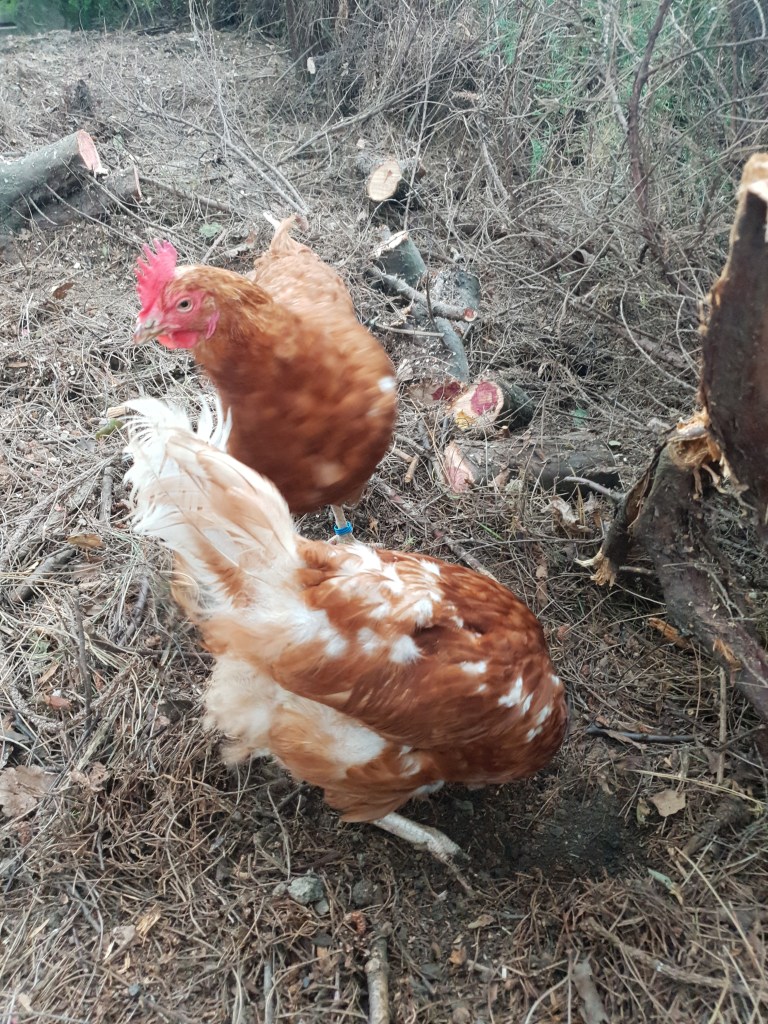
Please note I have no veterinary experience at all, if your hen is showing signs of distress or discomfort please consult a qualified vet, these are just things I’ve picked up along the way.
Setting Up – what you need.
The chicken coop needs to be large enough for the hens, experience tells me to delete 2 from the number suggested on any website. E.g. if it says for 6 hens, assume that means 4 maximum. Wooden coops are prettier and usually slightly cheaper, but there is more risk of red mite.
The chicken run needs to be fox proof, with a roof and skirting to stop predators digging under the edge. Again assume that the size per chicken is too small, our first run should have been large enough for 6 hens, the husband spent the first week tripling the size of the run.
Food and water hoppers are essential, fully grown chickens will need either layer mash or layer pellets, (we use both as we have a couple of birds with wonky beaks that find pellets difficult to eat). And fresh water every day. (Food should be freely available in the run, but take it out at night to avoid vermin).
Treats are always fun for hens, ours love grapes (cut up so they don’t choke), sweetcorn and broccoli, they will hoover up almost anything, but try to keep human carbs to a minimum.
Protein is great for ex commercials that need to regrow feathers, or any bird following moult, sunflower hearts are excellent, as is a bit of scrambled egg (don’t feed raw egg, they might get a taste for it).
Poorly hen – the signs.
An ill hen will attempt to mask any symptoms, as flock birds they tend to be fairly unforgiving of weaker members. However there are some tell tale signs:
Standing still, usually under a bush or other shelter.
Tail down.
Walking tall (like a penguin).
Fluffing up feathers to look larger.
Full crop in a morning.
Any out of character behaviour, you’ll recognise changes in them after just a few weeks.
If you notice any of these symptoms then it’s sensible to get expert advice.
Hen medicine cabinet.
It’s sensible to have a few things at the ready, purple spray is an antiseptic spray which has the added bonus of hiding any blood (chickens are very attracted to red, wear scarlet nail varnish at your peril).
A good wormer is required a couple of times a year, we use flubenvet pellets for a week at a time.
Vaseline is good to keep their combs frost free in winter and is effective against leg mites.
Epsom salts in a warm hen bath (bucket) have been invaluable in assisting our hens passing eggs when they appear to be struggling a bit.
Nutridrops are an all purpose pick me up which can perk up an under the weather hen quickly.
A small amount of apple cider vinegar added to the water is said to be good for healthy gut, but use only occasionally as it taken reduce calcium absorption which is vital for strong shells.
With our ex commercial hens we bought anti peck spray after a few days of bullying, it seems to work like that awful stuff parents paint on kids nails to stop them chewing – tastes vile.

Let’s make something together.
 Chicken Nuggets